Redefining the “Forever Home” in Southern New Hampshire

In the historic and evolving landscape of Nashua, New Hampshire, the concept of the “forever home” is shifting. It is no longer just about owning a property; it is about ensuring that property remains functional, safe, and welcoming through every stage of life.
As we approach 2026, the demand for accessible bathroom renovations has surged, driven by a desire to age in place with dignity and the recognition that accessibility does not require sacrificing aesthetics.
For homeowners in Hillsborough County, the challenge is distinct. Nashua’s housing stock ranges from Victorian-era homes in the North End to mid-century ranches and split-levels near the Massachusetts border. Renovating these spaces requires more than just installing a grab bar; it demands a sophisticated understanding of structural engineering, spatial planning, and Universal Design principles.
This comprehensive guide, prepared by Bath Refresh, serves as your master class in accessible remodeling. We will move beyond the clinical “hospital look” of the past and explore how modern technology, barrier-free design, and high-performance materials can create a bathroom that is as luxurious as it is safe.
Whether you are planning for your own future mobility or accommodating a multi-generational household, understanding the mechanics of a truly accessible bathroom is the first step toward long-term independence.
The Philosophy of Universal Design: Beyond ADA Compliance
A common misconception among homeowners is that an “accessible” bathroom must look institutional. At Bath Refresh, we advocate for Universal Design. While the Americans with Disabilities Act (ADA) provides strict measurements for commercial spaces, Universal Design is a broader philosophy intended for residential living. It aims to create environments that are usable by all people, to the greatest extent possible, without the need for adaptation or specialized design.
The Intersection of Safety and Luxury
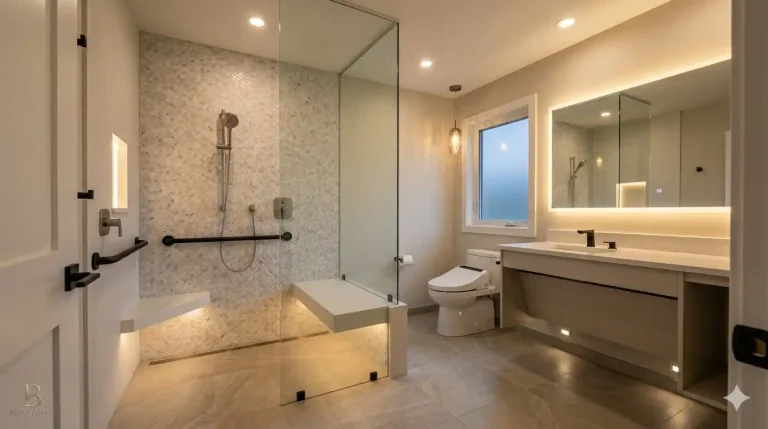
In the context of a Nashua home renovation, Universal Design means integrating safety features so seamlessly that they appear to be design choices. A zero-threshold shower, for example, is essential for a wheelchair user, but it also provides a sleek, modern aesthetic that appeals to any buyer.
Reinforced walls allow for the installation of designer grab bars that double as towel warmers or toilet paper holders, removing the stigma associated with safety equipment.
By focusing on usability for everyone (from a toddler learning to walk to a grandparent with limited mobility) we create spaces that add immense value to the home. The goal is to eliminate barriers before they become obstacles, ensuring the bathroom serves the user, rather than the user struggling against the architecture.
Critical Components of an Accessible Bathroom Remodel
Creating a safe environment requires a systematic approach to every fixture and surface. We analyze the bathroom in zones, addressing the specific hazards and usability requirements of each area.
The Curbless Shower System (Zero-Entry)
The traditional tub-shower combination is the single biggest hazard in a bathroom, requiring a high step-over on a slippery surface. The definitive solution for 2026 and beyond is the curbless, or barrier-free, shower.
Structural Considerations in Nashua Homes: Creating a true curbless shower in an existing New England home requires advanced carpentry. Because the drain must be lower than the rest of the bathroom floor, we often need to recess the subfloor between the joists.
Linear Drains: We utilize linear drains placed at the back or side of the shower. This allows for a single-slope floor, which is easier to navigate for wheelchairs and walkers compared to a traditional center drain that requires a “bowl” slope.
Waterproofing: With no curb to hold water back, the waterproofing system must be impeccable. This requires a comprehensive installation strategy where the waterproof membrane extends out into the main bathroom floor, effectively turning the area into a wet room to capture any over-spray or splashing.
Toilets and Personal Hygiene Zones
The standard toilet height of the past is insufficient for accessible design.
Comfort Height Toilets: We install fixtures with a rim height of 17 to 19 inches (chair height). This significantly reduces the strain on knees and hips when sitting or standing.
Bidet Integration: For individuals with limited range of motion, a bidet seat (washlet) restores independence in personal hygiene. Modern units require a dedicated electrical outlet near the toilet, a detail often overlooked in amateur renovations.
Support Structure: A key part of our rough-in process is installing comprehensive blocking (2×6 wood bracing) between the studs around the toilet area. This ensures that grab bars can be installed rock-solidly at any point in the future without ripping open the walls.
The Vanity: Clearance and Reach
A standard vanity cabinet blocks access for a seated user. Accessible design calls for a floating vanity or a console sink that provides knee clearance.
Plumbing Protection: When the area under the sink is open, the hot water pipes must be insulated or shrouded to prevent burns to the legs of a seated user.
Faucet Ergonomics: We exclusively recommend single-lever or touchless faucets. These can be operated with a closed fist or the back of a hand, which is crucial for users with arthritis or reduced grip strength.
Table: Comparison of Standard vs. Accessible Fixtures
Flooring and Slip Resistance: The Foundation of Safety

In Nashua, where winter boots track in snow and ice, the bathroom floor is a critical safety zone. The choice of material goes beyond color and pattern; it is a matter of friction.
Understanding DCOF (Dynamic Coefficient of Friction)
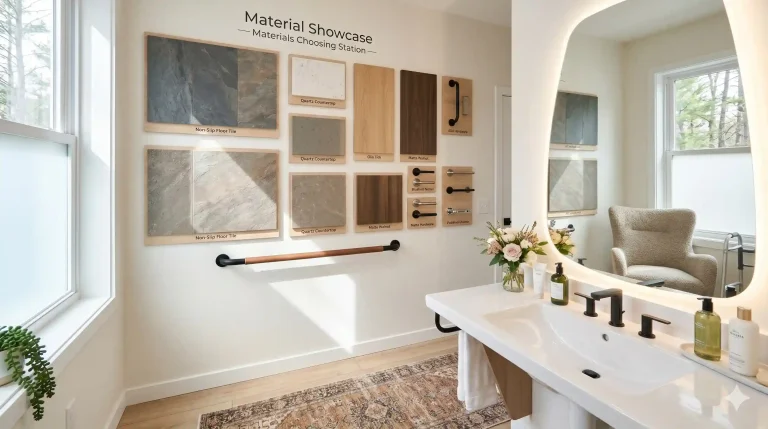
At Bath Refresh, we guide clients toward tiles with a high Dynamic Coefficient of Friction (DCOF). This is an engineering rating that measures how slippery a surface is when wet. For accessible bathrooms, we require a DCOF of 0.42 or greater.
Matte and Textured Finishes: We utilize wood-look porcelain planks or textured stone-look tiles that provide “grip” for bare feet and rubber cane tips.
Mosaic Tiles in Showers: Using smaller tiles (hexagons or 2×2 squares) in the shower area increases the amount of grout lines. These grout lines act as miniature traction strips, providing superior grip compared to large-format tiles.
Radiant Floor Heating as a Safety Feature
While often viewed as a luxury, radiant floor heating is a safety feature in the Northeast. By warming the floor, water evaporates much faster than on a cold surface. A dry floor is a safe floor. Additionally, keeping the ambient temperature comfortable helps keep muscles relaxed, which aids mobility for those with joint pain.
Visual and Cognitive Accessibility: Lighting and Contrast
Accessibility is not just about physical movement; it is also about vision and perception. As we age, our eyes require more light to see clearly, and our ability to distinguish between similar colors diminishes.
Layered Lighting Plans
A single ceiling light creates shadows that can obscure tripping hazards or make grooming difficult. We design a layered approach:
Ambient Lighting: Recessed LEDs to provide general, even illumination.
Task Lighting: Sconces placed at eye level on either side of the mirror to eliminate shadows on the face.
Night Lighting: Integrated toe-kick lighting under the vanity or motion-sensor lights in the toilet area. This is critical for preventing falls during middle-of-the-night bathroom trips, guiding the user without the shock of bright overhead lights.
Contrast and Depth Perception
For users with vision impairments, a monochrome white bathroom can be disorienting. We use contrasting colors to define boundaries. For example, a dark floor paired with light walls clearly indicates where the wall meets the floor. A contrasting border tile in the shower can help define the edge of the space.
Navigating Nashua’s Historic Architecture
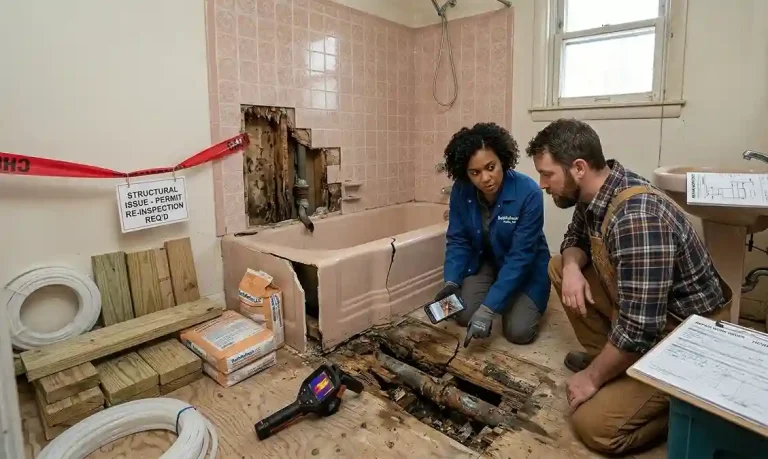
Renovating in Nashua presents unique structural challenges. Many homes in the French Hill or Crown Hill districts were built before modern building codes existed.
Widening Doorways in Load-Bearing Walls
Most older bathroom doors are 24 or 28 inches wide—too narrow for a walker or wheelchair. Widening these to a 32-inch clear opening often involves cutting into load-bearing studs. Bath Refresh LLC handles the structural header installation required to widen these openings safely, ensuring the integrity of your home’s framing while granting access.
Space Optimization in Small Footprints
New England bathrooms are historically small (often 5×8 feet). Making a small space accessible requires ingenuity. We often utilize:
Pocket Doors: Removing the door swing instantly frees up floor space for maneuvering.
Wall-Hung Toilets: By placing the tank inside the wall, we can gain 6 to 8 inches of floor space, which can be the difference between turning a wheelchair around or getting stuck.
The Installation Process with Bath Refresh

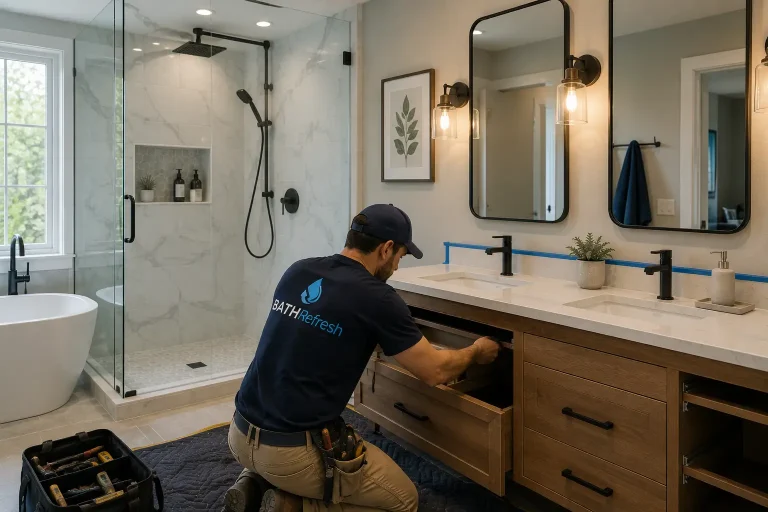
An accessible renovation is a construction project that disrupts your daily life. Our process is designed to minimize stress and maximize precision.
Step 1: In-Home Mobility Assessment
We don’t just measure walls; we measure you. We assess the user’s range of motion, height, and specific mobility challenges. Do you transfer from the left or right? Do you need a seated vanity? The design is customized to the human, not just the house.
Step 2: The Tear-Out and Structural Reinforcement
We strip the bathroom to the studs. This is when we widen doors, level uneven subfloors (common in older Nashua homes), and install the critical blocking for grab bars. We document all framing work.
Step 3: Waterproofing and rough-in
We install the mixing valves, set the linear drain, and apply the waterproofing membrane. This is the most critical phase for longevity. A leak in an accessible shower can cause massive damage; our systems are water-tested before tile is installed.
Step 4: Finishes and Fixtures
Tiles are set with precision to minimize lippage (uneven edges). Fixtures are installed at the predetermined ergonomic heights.
Step 5: Final Safety Walkthrough
We demonstrate the operation of all features, adjust anti-scald valves on showers, and ensure the homeowner is comfortable with the functionality of their new space.
Frequently Asked Questions (FAQ)
Does an accessible bathroom renovation lower the resale value of my home?
On the contrary, when done correctly using Universal Design principles, it increases value. A “hospital-style” bathroom might detract, but a luxury curbless shower, wide doorways, and comfort-height fixtures are highly desirable features for buyers of all ages. It future-proofs the home for the next owner as well.
How long does a tub-to-shower conversion take?
A standard conversion, which includes demolition, plumbing alterations, waterproofing, and tiling, typically takes between 5 to 8 days depending on the complexity of the tile work and inspections. A full bathroom gut renovation usually takes 3 to 4 weeks.
Do I need a permit for this renovation in Nashua?
Yes. The City of Nashua requires building, plumbing, and electrical permits for bathroom renovations. Bath Refresh handles all permitting, code compliance, and inspections with the city department, ensuring your project is legal and safe.
Can you install grab bars on my existing tiled walls?
It is risky if we don’t know what is behind the tile. Grab bars must be anchored into wood blocking or studs to support a human’s weight. Using toggle bolts on drywall or tile backer board is dangerous. Ideally, grab bars are planned during a renovation, but we can use specialized anchors if the stud location allows, though a full remodel offers the safest guarantee.
What is the difference between ADA compliant and Universal Design?
ADA compliance refers to strict legal standards for public and commercial spaces (specific heights, turning radii). Universal Design is a residential concept focused on making the home usable for everyone. In your private home, we can adapt ADA guidelines to fit your specific body and needs, which is often more comfortable than strict ADA adherence.
Are there grants available for accessibility renovations in New Hampshire?
There may be assistance available for veterans through the VA (SAH or HISA grants) or through local aging-in-place initiatives. We recommend consulting with local agencies, but Bath Refresh provides detailed quotes that can be used for these applications.
How do I clean a curbless shower?
They are actually easier to clean than tubs. With large format tiles and a hand-held shower wand, you can rinse the entire area down easily. There are no crevices or tracks (like in sliding glass doors) to collect mold and soap scum.
Conclusion: Investing in Independence and Quality of Life
An accessible bathroom renovation is more than just a home improvement project; it is a strategic investment in your quality of life. It provides the essential security of knowing that your home can adapt to your changing needs in 2026, allowing you to remain in the community you love with total peace of mind.
To ensure your bathroom becomes a sanctuary of both safety and style, we focus on:
Technical Accessibility Expertise: At Bath Refresh LLC, we combine specialized knowledge in barrier-free construction with a commitment to high-end design, ensuring your space is both functional and luxurious.
Structural Precision: We understand the specific architectural nuances of Nashua homes, implementing solutions like slip-resistant flooring and custom grab bar placement that integrate seamlessly with your home’s structure.
Long-Term Comfort: Whether it is the convenience of a barrier-free shower or the added comfort of heated surfaces, we design every detail to foster independence and support your lifestyle for years to come.
Ready to design a bathroom that supports your independence without compromising on aesthetic excellence? Contact Bath Refresh today for a comprehensive accessibility consultation and see how we can transform your space, or call our local experts directly at: (833) 308-3323